
Sprung vs Unsprung Weight Explained: Why It Matters
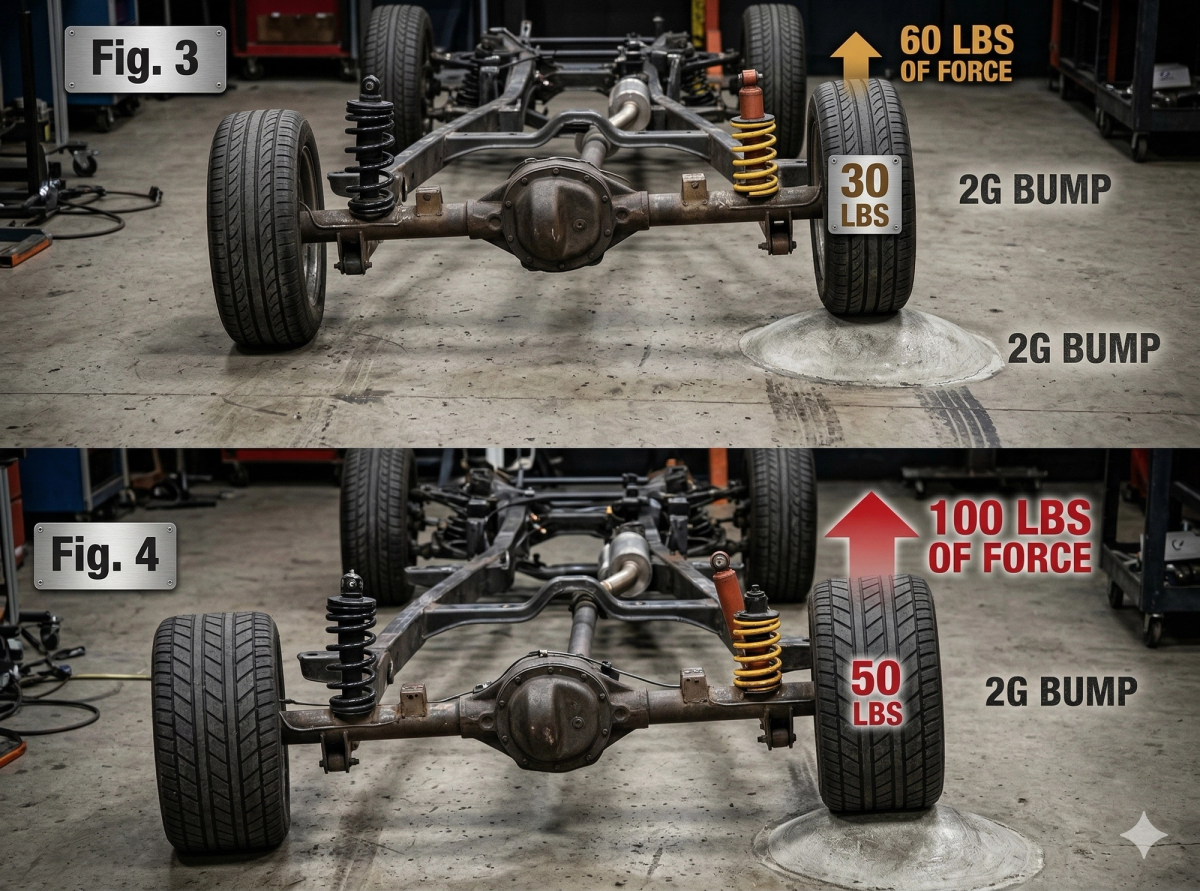
The Foundation of Vehicle Dynamics: Sprung vs. Unsprung Weight
In the automotive world, increasing performance usually brings to mind boosting engine power. However, there is a much more fundamental rule of physics that determines a vehicle's ride comfort, handling, and acceleration: where the vehicle's weight is located relative to its suspension system. When analyzing vehicle weight, engineers focus on whether this mass is "sprung" or "unsprung" rather than just the total mass.
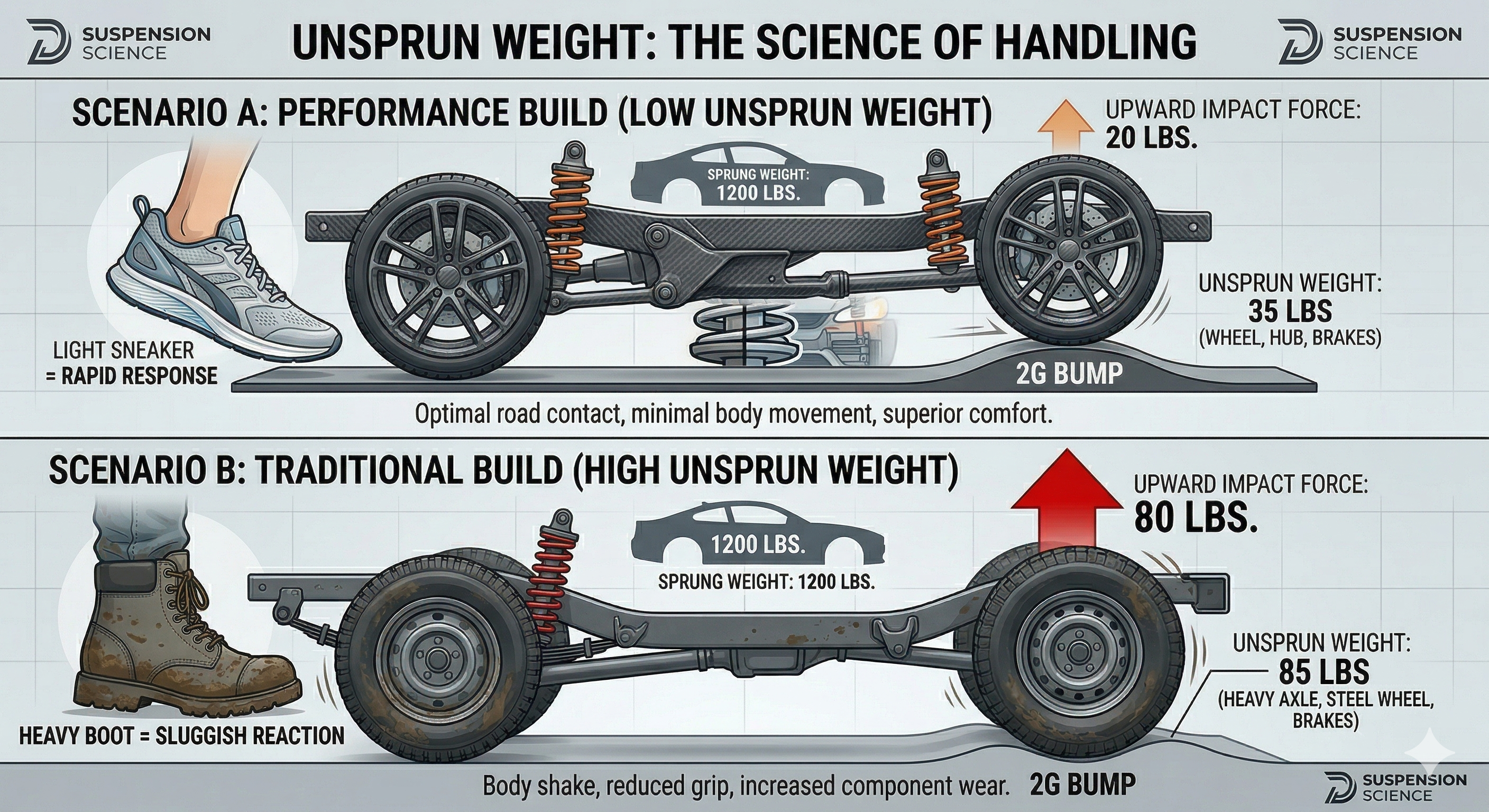
What is Sprung and Unsprung Mass?
We can essentially divide a vehicle into two parts right above its suspension springs:
- Sprung Mass: This is the portion supported by the suspension system. The vehicle's chassis, engine, bodywork, seats, passengers, and cargo fall into this category. This mass does not directly feel the impact created by potholes on the road; the springs and shock absorbers in between dampen this shock. The primary function of the sprung mass is to push the vehicle downward, strengthening the tires' contact with the ground.
- Unsprung Mass: These are the parts that remain below the suspension and are in direct contact with the road. Wheels, tires, brake rotors, brake calipers, and solid axles make up the unsprung mass. They are forced to move continuously and rapidly in a vertical direction over every bump on the road.
A Simple Physical Analogy:
If we think about this through the human body; our knees are our biological suspension, and our torso is our sprung mass. If you run with a 20-kilogram (44 lbs) backpack, you will get tired, but your knees can flex and tolerate this jolting. However, if you take this 20-kilogram weight off your back and wear it as heavy iron boots on your feet, running becomes impossible. Your leg muscles will be exhausted with every step. The same applies to vehicles; the heavier your wheels (unsprung mass) are, the harder your suspension has to work.
What is Sprung and Unsprung Mass?
The Multiplier Effect: The 1-to-4 Rule
The reason unsprung mass has such a massive impact on performance is that this mass (wheels and tires) doesn't just move vertically, but also rotates rapidly around its own axis (rotational mass).
According to the laws of physics, putting a rotating mass into motion or stopping it requires significantly more energy than a stationary mass. According to a generally accepted rule of thumb in the industry and racing world; every 1 unit of weight removed from the rotating unsprung mass (wheels) creates a feeling equivalent to removing about 3 to 4 units of weight from the vehicle's overall body (sprung mass). For example, when you save a total of 18 kg (40 lbs) from four wheels by using lightweight rims, the vehicle's acceleration and braking feel sharpens as if 55-60 kg (about 120 lbs) had been stripped from the car.
In real-world tests, shedding about 5.5 kg (12 lbs) per corner on a vehicle like the Mazda Miata improved its 0-100 km/h (0-60 mph) acceleration by 0.29 seconds. For comparison, adding a static 19 kg (42 lbs) to the car's trunk only slowed it down by 0.14 seconds.
Advantages of Low Unsprung Mass
If you are driving your vehicle on asphalt, keeping the unsprung mass to a minimum (e.g., using lightweight forged wheels) is always best.
- Handling: When a lightweight wheel hits a pothole, it bounces instantly and is pushed back to the ground by the suspension in a fraction of a second. This ensures the tire's contact with the asphalt is not broken.
- Ride Comfort: When a heavy wheel passes over a bump, it generates massive upward energy, and if the suspension cannot contain it, the shock hits the cabin directly. With lightweight wheels, this shock is very low, and the vehicle glides over the road.
- Braking Performance: When rotational mass is lightened, the inertia that the braking system has to stop is reduced. This shortens braking distances and prevents the brakes from overheating and fading.
A Completely Objective Analysis: In What Situations Is Heavy Unsprung Mass Necessary?
A Completely Objective Analysis: In What Situations Is Heavy Unsprung Mass Necessary?
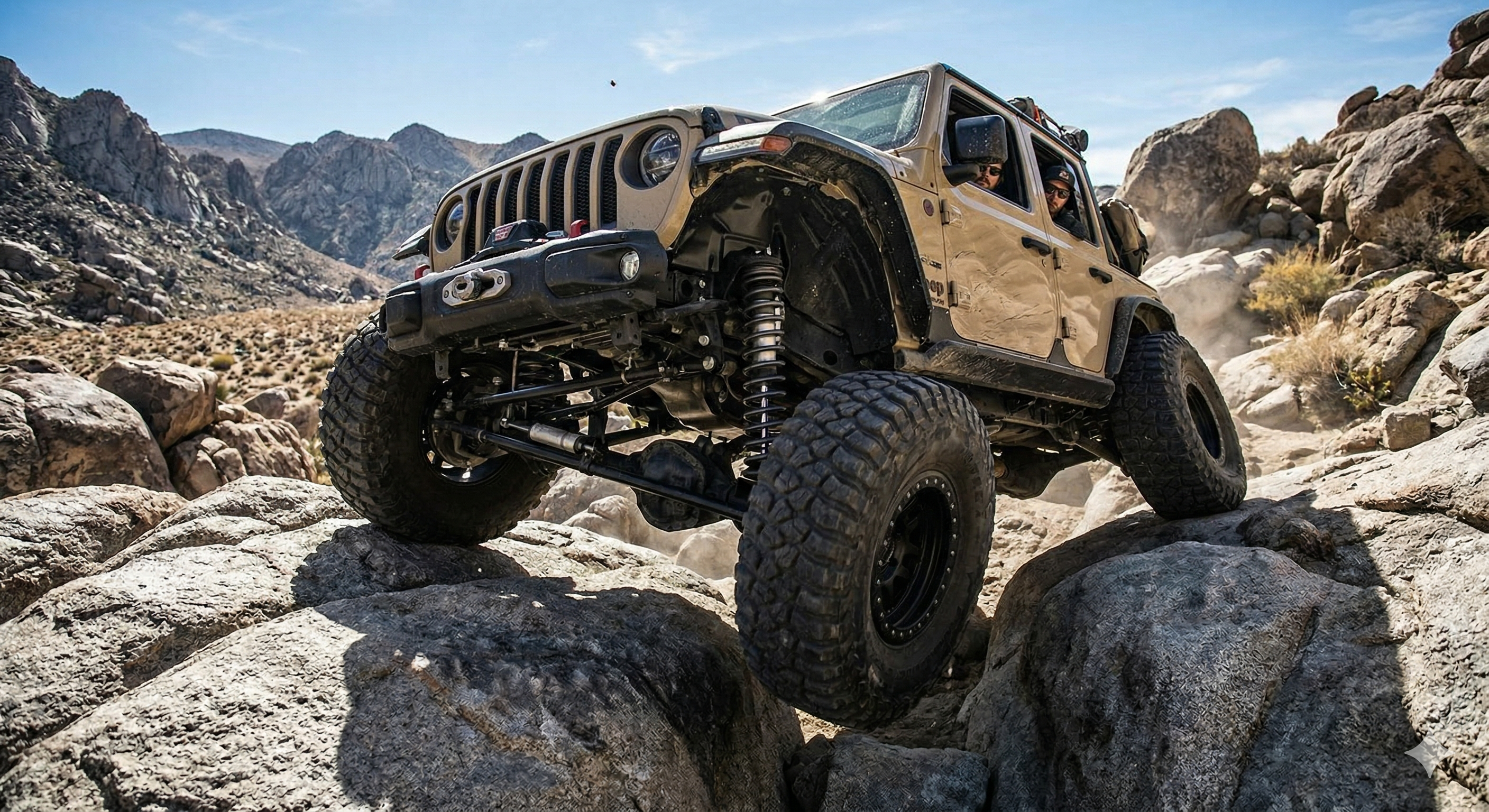
While "lightness" is the rule for asphalt-focused driving, the rules are completely reversed when the vehicle leaves the asphalt and enters extreme natural conditions.
- Rock Crawling and True Off-Road: In purebred off-road vehicles like the Jeep Wrangler and Ford Bronco, massive, single-piece "Solid Axles" and large mud tires are used instead of independent suspension. This enormous unsprung weight pulls the vehicle's center of gravity towards the ground, preventing it from rolling over (via a pendulum effect) on steep inclines. Furthermore, the heavy axle powerfully presses the other tire to the ground when one tire is on a rock, maximizing traction.
- Loose Gravel and Dirt Roads: On gravel and dirt roads that produce high-frequency small vibrations, heavy wheels offer an interesting advantage. The heavy wheel/tire combo absorbs the impact energy of small stones within its massive mass and does not transmit it to the chassis (acting as an inertia shield). Therefore, heavy wheels provide a smoother ride inside the cabin on unpaved roads.
Optimization by Vehicle Segment (Which is Better for Which Vehicle?)
The ideal point of the sprung/unsprung mass balance varies depending on the vehicle's segment:
- A-Segment and Light Sports Cars (e.g., Mazda MX-5): The body weight (sprung mass) of these vehicles is already very low. Because of this, even the slightest change in unsprung mass immediately disrupts the vehicle's balance. Vehicles in this segment absolutely cannot tolerate heavy rims; the lightest alloy wheels tremendously improve their ride quality.
- Standard Sedans: Built for comfort and daily use, these vehicles come with ideal wheel sizes from the factory. Installing large and heavy cast wheels like 19-20 inches on these cars for aesthetic reasons disrupts the suspension's operating range, stiffens the ride, and causes the car to bounce over speed bumps.
- Urban SUVs and Crossovers: Due to visual trends, manufacturers equip these vehicles with huge (19-21 inches) and heavy wheels. However, if a Hyundai Santa Fe user switches from heavy 19-inch wheels to smaller diameter and lighter 17-inch wheels, it provides serious weight savings per corner, relaxing the suspension and elevating the vehicle's comfort to what feels like a higher segment.
- True Off-Road Vehicles: As mentioned above, since durability and climbing ability in nature are prioritized over asphalt performance, heavy solid axles and massive wheel sets are a necessity for these vehicles.
In Summary
When it comes to driving dynamics, there is no single "right" answer. For all passenger cars and sports cars cruising on highways and winding asphalt roads, low unsprung mass (light wheels and brakes) means better acceleration, sharper handling, and high comfort. However, where civilization ends and asphalt gives way to mud and rocks, the only force that will keep your vehicle alive and carry you to the top is the unbreakable structure and unwavering stability provided by heavy unsprung mass.