
How Tesla OTA Updates Change Vehicle Behavior | Performance, Safety & Autopilot

What Are OTA Updates and How Do They Work?
OTA (Over-the-Air) updates are software update packages sent wirelessly (via Wi-Fi or cellular data) from Tesla servers to the vehicle. When an update is ready, the car notifies the user through the mobile app and the touchscreen interface; once downloaded, it can be installed immediately or scheduled for a convenient time. For example, the process typically occurs in two stages while the car is parked: download and installation. During the download phase, an internet interruption pauses the download but the vehicle remains usable; once installation begins, the car must stay parked and the process usually completes within 15–30 minutes. OTA updates are similar to smartphone updates: every module, from the infotainment system to driver assistance software, can receive new code.
Security and Encryption Approaches
Update packages are securely encrypted and digitally signed. Tesla uses strong symmetric encryption such as AES-256 to encrypt data, while applying standard protocols like RSA for key exchange and SHA for ensuring integrity during transmission. If the update package is altered from its original signature, the vehicle detects it and prevents installation. Additionally, following a “layered security” approach, Tesla ensures that only authorized software can be installed through measures like code signing and Secure Boot. Tesla also uses encrypted channels for communication between software modules within the vehicle. All these measures make it difficult for malicious actors to inject fake updates or disrupt the update process. For example, Tesla’s internal audits and bug bounty program help identify vulnerabilities and enable rapid OTA patches to fix them.
Version Management and Deployment
Tesla delivers updates in phases, grouping vehicles based on their hardware configurations. Each vehicle reports its software version to Tesla servers; the server determines which Electronic Control Units (ECUs) the vehicle supports and which software version it is running. Some updates are only suitable for specific hardware (for example, the Comfort Braking feature for the dual-cylinder brake system in the new Model Y was only released for newer-generation Model Y vehicles). Additionally, new feature updates are often delivered earlier to vehicles enrolled in “Advanced” update mode. Users can configure update preferences (Immediate, Standard, Advanced), allowing updates to be downloaded primarily over Wi-Fi connections.
Real-World Examples: Changes in Vehicle Behavior
The following examples are compiled from official release notes, independent reviews, and user reports. They demonstrate real-world changes in driving behavior, autonomous driving features, energy management, and more.
Braking and Deceleration (Comfort Braking)
In March 2026, update version 2026.8 (for the refreshed Model Y) introduced the “Comfort Braking” feature. Official notes describe it as enabling smoother stops during routine braking, eliminating the slight jerk between pressing the brake pedal and coming to a complete stop. According to sources, this feature creates a “chauffeur-like stop,” making the final halt seamless. This software-driven improvement enhances the transition between regenerative braking and friction braking, especially in Model 3/Y vehicles. As seen in earlier examples, a similar update in 2018 reduced the Model 3’s stopping distance from 152 feet to 133 feet from 60 mph.
Autonomous Driving (Autopilot/FSD) Behavior
Tesla updates continuously improve Autopilot and Full Self-Driving (FSD) algorithms. For example, version 2026.2.9.2 introduced FSD (Supervised) v14.2.2.5, which increased neural network resolution, improving detection of emergency vehicles, road closures, and human signals at intersections. According to reports, a Model Y was able to autonomously reverse when encountering a blocked path caused by a large truck. The same update also introduced driving profile options such as “SLOTH” (very cautious) and “MAD MAX” (aggressive), allowing users to customize driving behavior. These changes demonstrate how software updates directly influence vehicle control.
Energy Management and Battery
Tesla can update battery charging curves and range estimation algorithms through software. Updates may optimize battery preconditioning speed or Supercharger charging curves, improving both range and charging time. Additional features like climate control optimizations, low-power modes, and new charging scenarios can also be introduced, enhancing perceived range during driving.
Navigation and Trip Planning
Updates to mapping and navigation software can introduce new routing options, improvements to charging infrastructure integration, and advanced driving assistance features such as overtaking suggestions or alternative routes in case of road closures.
Connectivity and Infotainment
Tesla OTA updates also enhance music applications, voice commands, and overall user interface (UI). Recent updates have introduced improvements to voice assistants, 3D icons, interface redesigns, and new streaming services.
These changes are quickly noticed by vehicle owners through official forums and independent reviews. For instance, a May 2018 OTA update adjusted the Model 3’s anti-lock braking algorithm, reducing stopping distance by 19 feet in a challenging test. Similarly, recent updates have smoothed Autopilot braking responses, reducing the sensation of abrupt stopping. Such data proves that OTA updates can significantly impact real-world driving.
Hardware Limitations and Software–Hardware Interaction
Although Tesla software is highly versatile, hardware capacity imposes certain limits. For example, advanced image processing algorithms with higher resolution can only run on newer infotainment (MCU) units. Hardware improvements, such as the dual-cylinder braking system in the refreshed Model Y, enable certain software features that older vehicles cannot support. Memory and processor limitations in older vehicles may also prevent deployment of new graphical interfaces or large neural network models. Therefore, Tesla sometimes indicates that certain updates are only available on specific vehicles. While older Tesla models may not benefit from all features, core safety and driver assistance updates are generally deployed across all supported hardware.
Safety and Regulatory Implications
OTA updates provide significant safety advantages: bugs and vulnerabilities can be fixed rapidly, and many recalls can be resolved via software. For example, regulatory bodies such as NHTSA have acknowledged that certain issues in Tesla vehicles can be resolved without physical service. In December 2024, Tesla announced that a TPMS warning light issue affecting over 700,000 vehicles would be fixed via OTA, and NHTSA officially categorized it as a “software remedy.” This represents a major regulatory recognition of OTA-based safety compliance.
However, evolving software also introduces risks. Post-update regressions may occur, potentially affecting response times or energy management. OTA updates themselves can also become a cybersecurity attack surface. Therefore, both internal validation processes (code reviews, simulation testing, signature verification) and user-side caution are important. A prudent approach is to monitor early user feedback before installing new updates. From a regulatory perspective, frameworks such as UNECE WP.29 cybersecurity standards in Europe are expected to formalize OTA update requirements, making update infrastructure part of certification processes.
User Experience and Risks
OTA updates are generally well received by Tesla owners, but there are practical considerations. Timing is critical: since the vehicle cannot be used during installation, scheduling updates during idle periods is recommended. Some users may notice changes in driving behavior after updates. For example, in mid-2024, some Model 3 owners reported slight differences in braking feel after a software update. In such cases, users should review driving mode settings (e.g., Chill, Standard) and recalibrate if necessary. Additionally, staggered rollout means some vehicles may receive updates later, potentially continuing to experience older issues. Keeping the vehicle updated ensures compliance with regulations and optimal safety.
Rollback Processes
Once an OTA update is installed in a Tesla, users cannot manually roll it back. Rollback functionality is not widely supported. Instead, if a serious issue arises, Tesla typically releases a follow-up patch update. For example, the 2018 Model 3 braking update was quickly followed by a corrective OTA patch. Tesla service centers rarely perform manual software rollbacks; instead, a new update wave is deployed. Users may note their current software version before updating, but resolving faulty updates usually requires official Tesla support or a system reset.
Code and Algorithm-Level Updates
Tesla OTA updates often introduce new parameter configurations and updated neural network models into integrated control systems. For example, Autopilot/FSD updates may include updated neural network weights. Driving control algorithms—such as Adaptive Cruise Control (ACC), Electric Power Steering (EPS), and Anti-lock Braking System (ABS)—may receive updated constants (e.g., braking thresholds, speed limits) and feedback loop parameters. From a software perspective, updates typically consist of two components: application software (infotainment/UI) and embedded ECU software (brakes, motor, sensors). For instance, an ABS update might modify threshold values in the control loop that regulates brake pressure based on wheel slip detection. In general, each update modifies the system through new code blocks or parameters representing the latest algorithmic state. Tesla’s adoption of agile software development and continuous integration allows rapid deployment of tested updates compliant with automotive standards.
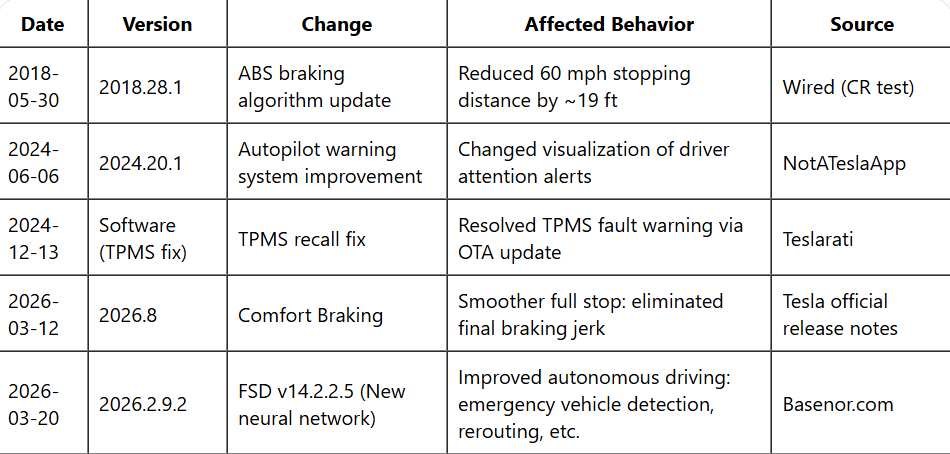
(Table: Change summaries and effects of different OTA releases.)
Recommendations: Best Practices for Manufacturers and Users
For Manufacturers:
Deliver updates with a robust testing infrastructure. Encrypt and sign update packages from the outset, and design OTA processes according to automotive security standards. Collect telemetry and system data after each update to monitor integrity. Establish rollback strategies or rapid patch deployment mechanisms. Provide user-controlled update settings (postponement, prioritization). Ensure timely release of critical safety updates and maintain transparent communication with regulatory bodies.
For Users:
Keep your vehicle software up to date, as updates often include safety and efficiency improvements. Review release notes before installing updates and follow trusted sources. Schedule installations during periods when the vehicle is not needed. Take a short test drive after updates to adapt to new driving behavior. If issues arise, consult Tesla forums or service support. Finally, if unexpected behavior occurs (e.g., unusual deceleration or new warnings), have the vehicle inspected.
Conclusion
In an era where vehicles are increasingly “software-defined,” Tesla’s OTA updates have become a key technology capable of significantly altering vehicle behavior. The examples and technical insights discussed here show that Tesla owners can experience continuous improvements in acceleration, braking, autonomous driving, and energy management over time.
As a call to action: Tesla owners should actively monitor updates, review release notes, and stay informed through early user feedback. Manufacturers, on the other hand, should improve update processes through transparency and robust engineering practices. This ensures that vehicle software continues to evolve safely and seamlessly.
Assumptions
This analysis primarily considers Tesla vehicles with modern hardware, such as Model 3/Y (post-2017) and Model S/X (post-2021). The referenced release notes and cases reflect general user experiences. For unknown variables, standard OTA deployment processes and general security practices are assumed.
Sources
Information compiled from Tesla official documentation, release notes, industry publications (Wired, Teslarati, Basenor, Recharged, etc.), and cybersecurity research.