
Most Reliable Diesel Engines: Proven Models, Performance & User Satisfaction
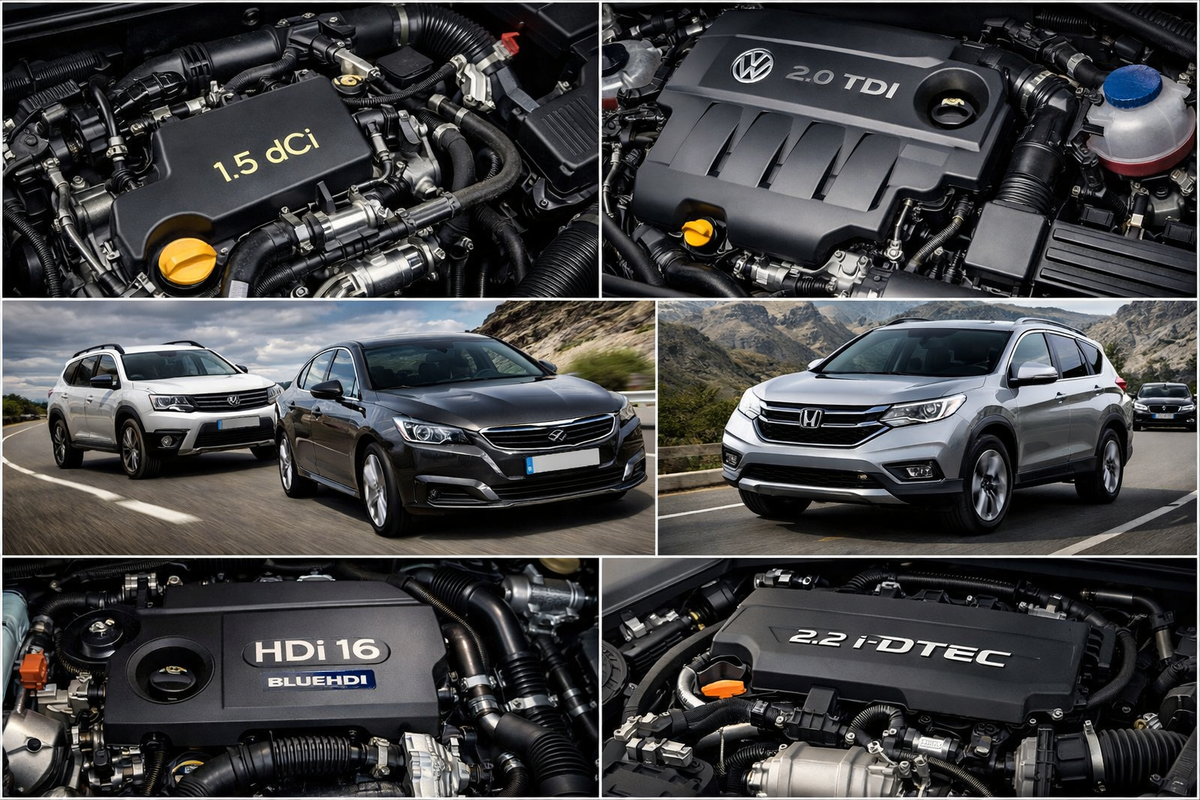
Diesel engines are still indispensable, especially for long-distance drivers and commercial users. However, not every diesel engine offers the same level of durability and reliability. In this article, we examine diesel engines that have proven themselves over the years, maintain high user satisfaction, and have minimal chronic issues—along with their design, driving characteristics, criticisms, and sales performance.
1. 1.5 dCi (K9K)
The 1.5 dCi (K9K) is a 1.5-liter four-cylinder diesel internal combustion engine developed through the Renault–Nissan partnership. Introduced in 2001, this engine has found widespread use in compact vehicles across Europe thanks to its low fuel consumption and longevity.
Overview
One of the most successful diesel engines of the Renault–Nissan alliance. It has a wide range of applications, from compact cars to light commercial vehicles.
Basic Information
Manufacturer: Renault Group (co-developed with Nissan)
Production Start: 2001
Displacement: 1,461 cc
Fuel System: Common-rail direct injection
Why Is It Reliable?
Simple and durable engineering
Low fuel consumption
Easy access to parts and service
Criticism
Injector sensitivity in older versions
Noise at high RPM
Design and Driving
It delivers linear power. Not performance-focused, but optimized for economical use.
The K9K engine belongs to Renault’s “Energy” engine family and has been offered in various power outputs (65–110 hp) over time. With its common-rail injection system and variable geometry turbo (in some versions), it achieves high efficiency. Durability is enhanced through steel pistons and an optimized lubrication system.
Sales and Popularity
Used in models such as Renault Clio, Megane, Dacia Duster, Dacia Logan, Nissan Micra, and Qashqai
Used in over 10 million vehicles worldwide
User Satisfaction
Low failure rate
Low maintenance cost
High satisfaction, especially among fleet users
Reliability and Maintenance
The K9K engine is known to exceed 300,000 km without major issues when properly maintained. Although early versions had turbo and injector problems, these were largely resolved in later generations. It is considered one of Renault’s most successful diesel engines.
2. 1.6 TDI
The 1.6 TDI engine from the Volkswagen Group is a 1.6-liter, four-cylinder, turbocharged diesel engine with common-rail injection, introduced in 2009 as part of the EA189 and EA288 engine families. It is known for fuel efficiency and low emissions and has been used in many models such as the Volkswagen Golf, Audi A3, Škoda Octavia, and SEAT Leon.
Basic Information
Displacement: 1,598 cm³
Configuration: Inline 4, DOHC, 16 valves
Fuel System: Common-rail direct injection
Power Range: 75–120 hp
Torque: 195–270 Nm
Emission Standard: Euro 4–6
Why Is It Reliable?
Long-lasting turbo system
Balanced performance and efficiency
Criticism
Mechatronic issues when paired with DSG (transmission-related, not engine-related)
Sluggish feel during initial acceleration
Design and Driving
Quiet with low vibration. Comfortable in urban use and economical on long drives.
Sales and Popularity
Volkswagen Golf, Passat, Skoda Octavia
Millions of sales in Europe, especially dominant in fleet markets
User Satisfaction
Long service life
Meets fuel consumption expectations
Strong demand in the used car market
3. 2.0 HDi / BlueHDi
The legendary engine of the PSA Group used in Peugeot and Citroën models.
The 2.0 HDi (High-pressure Direct Injection) and BlueHDi are a family of 2.0-liter four-cylinder diesel engines developed by PSA Group (now Stellantis). These engines have been widely used in Peugeot, Citroën, and DS Automobiles models and are known for fuel efficiency, durability, and low emissions.
Basic Information
Manufacturer: PSA Group (now Stellantis)
Displacement: 1,997 cc
Cylinder Count: Inline 4
Fuel System: Common-rail direct injection
Emission Technology: BlueHDi (SCR + AdBlue, post-Euro 6)
Why Is It Reliable?
Robust engine block
High mileage durability (500,000 km examples are common)
Criticism
EGR and DPF clogging risk (in short-distance use)
AdBlue system-related costs (BlueHDi)
Design and Driving
Smooth and refined operation. High long-distance comfort. This engine family offers various power outputs ranging from 90 to 180 hp. BlueHDi versions stand out with low fuel consumption thanks to higher compression ratios and optimized combustion processes. Most versions are compatible with both manual and automatic transmissions and are used in sedans, SUVs, and light commercial vehicles.
Sales and Popularity
From passenger cars like Peugeot 308, 508, Citroën C5, DS 5 to commercial vehicles like Peugeot Expert and Citroën Jumpy
Widely used across Europe, especially in company fleets
Current Status
BlueHDi technology remains central to PSA’s diesel strategy, still preferred in Stellantis Euro 6d-compliant models due to low CO₂ emissions and high torque output.
User Satisfaction
Long lifespan
Balanced performance and efficiency
However, satisfaction may decrease in short urban usage
4. 2.0 TDI
The 2.0 TDI is a series of four-cylinder turbo diesel engines developed by the Volkswagen Group. “TDI” (Turbocharged Direct Injection) refers to turbo diesel engine technology with direct injection. This engine family has been widely used across Audi, Škoda, SEAT, and Volkswagen models, offering a balance between fuel economy and performance.
Basic Information
Manufacturer: Volkswagen Group
Engine Displacement: 1,968 cm³
Configuration: Inline 4-cylinder (I4)
Fuel Type: Diesel
Power Range: Approximately 100–240 hp
Why Is It Reliable?
Continuously improved over the years
High torque and durability
Criticism
Injector and oil pump issues in older generations
Perception issues after the emissions scandal
Design and Driving
Strong pulling power, especially excellent on long journeys. The 2.0 TDI replaced the 1.9 TDI in the mid-2000s, offering higher performance, lower emissions, and improved refinement. Early generations used the Pumpe-Düse injection system, while common-rail became standard after 2007, improving efficiency and environmental performance.
Emissions and Environmental Standards
The engine family has been adapted over time to meet Euro emission standards. Transitioning from Euro 4 to Euro 6 introduced particulate filters (DPF) and selective catalytic reduction (SCR) systems. Following the 2015 Volkswagen emissions scandal (“Dieselgate”), emission controls were revised in some models via software updates.
Sales and Popularity
Audi A4, Volkswagen Tiguan
One of the best-selling diesel engines worldwide
Performance and Usage
Known for strong low-end torque and high efficiency. Used across a wide range from compact hatchbacks to SUVs. Power variants range from economical 100 hp versions to 240 hp biturbo performance versions. It has remained popular in the European market for many years due to its durability.
User Satisfaction
High performance
Long lifespan
Maintenance costs are reasonable for its segment
5. 2.2 i-DTEC
The 2.2 i-DTEC is a four-cylinder turbo diesel engine developed by Honda Motor Co., Ltd. Introduced in 2008, this unit is one of the first members of the brand’s “i-DTEC” (intelligent Diesel Technology) family and was designed to offer a clean diesel option for Honda models, particularly in the European market.
Basic Information
Displacement: 2.2 liters (2,199 cc)
Power: Approximately 140–180 hp (depending on version)
Torque: 340–380 Nm
Fuel System: Common-rail direct injection
Production Period: Around 2008 – 2015
Why Is It Reliable?
Japanese engineering and low failure rates
Chain-driven structure with long maintenance intervals
Criticism
High parts costs
Perception of limited service network in Turkey
Design and Driving
The 2.2 i-DTEC was developed to replace Honda’s earlier 2.2 i-CTDi engine. Its aluminum engine block provides lower weight and better heat management. It uses a diesel particulate filter (DPF) and advanced exhaust gas recirculation (EGR) system to meet Euro 5 emission standards. A variable geometry turbocharger balances low-end torque with high-end power.
Sales and Popularity
Honda CR-V, Accord
More limited presence in Europe but with a loyal user base
Development and Legacy
After 2013, Honda gradually phased out this engine by introducing the more compact and efficient 1.6 i-DTEC. However, the 2.2 i-DTEC is still remembered as a symbol of Honda’s engineering success in diesel technology.
User Satisfaction
Very low failure rate
Long-term trouble-free use
Owners are generally highly loyal to the brand
General Evaluation
Standout Engines in Terms of Reliability
Durability: 2.0 HDi, 2.0 TDI
Efficiency: 1.5 dCi
Balance: 1.6 TDI
Premium reliability: 2.2 i-DTEC
The Common Reality
No diesel engine is completely problem-free. Usage style is decisive:
Short-distance driving = DPF/EGR issues
Low-quality fuel = injector problems
Poor maintenance = turbo failures
Factors Determining User Satisfaction
Fuel consumption expectations
Service costs
Not the frequency of failures, but the cost of failures
Resale value